What to Look for in a Checking Account

Some links in this article are affiliate links, meaning we may earn a commission at no extra cost to you.
Choosing a checking account seems simple, but the wrong one can quietly cost money and make managing your finances harder. What to look for in a checking account comes down to a few core factors: low or no fees, easy access, simple money movement, and a setup that fits how you actually use your money.
For most people, the best checking account is one with no monthly fees, a strong mobile app, and simple automation that makes managing money easier day to day.
The right account should be easy to use, low-cost, and built around your habits—so managing your money feels simple instead of something you have to constantly adjust.
Read Best Banks to see our top picks.
What to Look for in a Checking Account (Quick Answer)
Choosing a checking account comes down to a few core factors that affect how easy it is to manage your money day to day.
| Feature | What to Look For | Why It Matters |
|---|---|---|
| Fees | $0 or easy to waive | Avoids $100+/year |
| App | Fast and reliable | Easier daily use |
| ATM Access | Large network / reimbursements | Fewer withdrawal fees |
| Transfers | Instant or 1–2 days | Keeps money moving |
| Automation | Bill pay + recurring transfers | Less manual work |
In real-world use, the best checking accounts usually feel simple and predictable day to day. If transfers, bill payments, direct deposit, and mobile banking work smoothly, the account is usually a much better long-term fit.
No or Low Monthly Fees
Monthly fees are one of the biggest things to watch. Even a $10 fee adds up to about $120 per year, so starting with an account that doesn’t charge one is usually the simplest option.
Easy Access (App and ATMs)
Access matters in a practical way. A reliable mobile app and easy ATM access tend to have a bigger impact than whether a bank has physical branches.
Simple Money Movement
Moving money should feel simple. Transfers, direct deposit, and bill pay should work smoothly so you’re not constantly dealing with delays or extra steps.
A Setup That Fits Your Habits
What ties it all together is how well the account fits your habits. If you have to keep adjusting or moving money around just to make things work, it’s usually not the right setup.
Checking Account Fees and Costs to Watch For
Fees are one of the most important factors when choosing a checking account because they directly reduce how much money you keep. Even small charges can add up quickly if they happen regularly.
Monthly Fees and How to Avoid Them
Many checking accounts charge monthly maintenance fees, typically ranging from $0 to $15. While some banks allow you to waive these fees by meeting certain conditions—like setting up direct deposit or maintaining a minimum balance (often $500–$1,500)—those requirements don’t always fit how you use your account.
Accounts with no monthly fees or very simple waiver conditions tend to be easier to manage long term:
- $0 monthly fee — avoids $100+ per year in unnecessary costs
- Simple waiver conditions — easier to meet consistently
- Fewer requirements — less to track just to keep the account free
If avoiding fees depends on multiple conditions, it’s usually a sign the account will be harder to manage over time.
Common Hidden Fees to Watch For
Beyond monthly fees, there are a few common charges that can show up unexpectedly:
- Overdraft fees — typically $30 to $35 per occurrence
- ATM fees — often $4 to $6 per withdrawal (which can add up to $50–$100+ per year if used regularly)
- Transfer or account-related fees — vary by bank, but less common with newer or online-focused accounts
If you see multiple small fees listed, it’s usually a sign the account will be harder to manage over time.
Interest (APY): Does It Matter for Checking Accounts?
Most checking accounts offer little to no interest, and when they do, it’s often under 1.00% APY unless specific conditions are met.
While interest-bearing checking accounts exist, they usually come with requirements like minimum balances or transaction thresholds. Based on how these typically work, the benefit is often small compared to what you could earn in a separate high-yield savings account.
In general, it makes more sense to prioritize low fees and ease of use over chasing small interest gains within a checking account, especially if you already keep savings in a higher-yield account.
Why Checking Account Usability Matters
Ease of use has a bigger impact on your finances than most people expect. If your account is slow or confusing, even simple tasks become harder to stay consistent with.
If managing your account feels frustrating, it’s usually a sign the setup isn’t a good fit.
Mobile App and Online Experience
The mobile app is where most people manage their money, so speed and simplicity matter more than almost anything else.
| Feature | Poor Experience | Strong Experience |
|---|---|---|
| App Speed | Slow, laggy | Fast, instant |
| Transfers | Delayed | Instant or 1–2 days |
| Navigation | Confusing | Simple and clear |
| Alerts | Limited | Real-time notifications |
A strong app makes it easy to:
- Check your balance instantly
- Review transactions clearly
- Move money without delays
If the app is slow or confusing, it affects how often you stay on top of your money—which is where problems usually start.
For most people, this matters more than having a physical branch.
Transfers, Payments, and Automation
A checking account should make it easy to move money where it needs to go.
Look for:
- Fast transfers (instant or 1–2 days)
- Simple bill pay setup
- Recurring transfers or payments
Automation is what makes everything work long term. Scheduling transfers and bills reduces manual work and helps avoid missed payments.
Alerts and Visibility
Clear tracking and real-time alerts help you stay aware of what’s happening in your account.
This includes:
- Purchase notifications
- Low balance alerts
- Deposit confirmations
Visibility makes a bigger difference than most people expect. A balance might look like $2,000, but if $1,500 is already committed to bills, it changes how much you can actually spend.
Making It Work Together
If you want everything to run smoothly, your checking account should connect easily with your other accounts.
A simple setup that links checking, budgeting, and savings makes it easier to stay organized without constantly moving money around.
If you want a simple way to set this up, you can use a structured approach like the Savefinity System to connect your checking, budgeting, and savings so everything works together without constant manual effort.
ATM Access, Cash Deposits, and Mobile Banking
Access to your money still matters, even though most transactions are digital. The key is understanding how often you actually use cash and how your account supports that, since this determines whether ATM fees or branch access will actually impact you.
Online banks have adapted to this shift by expanding ATM access and removing many of the traditional limitations. Instead of relying on branches, they often offer large ATM networks (30,000+ machines) or reimburse out-of-network fees, which covers most everyday cash needs without requiring a physical location.
ATM Networks and Fees
Many banks offer access to large ATM networks, while others reimburse fees from out-of-network machines. What “free ATM access” means can vary, so it’s worth looking at how the account handles withdrawals.
- Large ATM networks — easier to find free machines nearby
- Fee reimbursements — flexibility to use almost any ATM
- Out-of-network fees — usually $4–$6 per withdrawal if not covered
If you rarely use cash (0–2 withdrawals per month), this may not matter much. But if you rely on ATMs regularly (3+ times per month), fees can add up quickly without the right setup.
Branch Access (When It Actually Matters)
Physical branches can still be useful for certain situations, like depositing cash or handling more complex issues. However, for everyday use, most people rarely visit a branch.
Because of this, online banks have shifted toward digital-first support, with faster apps, customer service, and easier transfers replacing many reasons people used to visit branches. For most people, this covers nearly everything they need without requiring in-person access.
Branch access tends to matter most if you regularly deposit cash or prefer face-to-face support. Otherwise, a strong digital setup usually provides a simpler and more flexible experience.
Common Types of Checking Accounts
Understanding the different types of checking accounts helps put your options into context, but the differences are usually straightforward.
The most common checking account types include:
- Standard checking — basic everyday use with simple features
- Online checking — lower fees and better digital experience
- Rewards or interest checking — extra benefits, often with conditions (such as 10–15 debit transactions per month)
Online checking accounts typically offer lower fees and better digital tools because they don’t operate physical branches, which is why they show up frequently in lists of the best banks.
Weak vs Strong Checking Account Setup Examples
A simple way to evaluate a checking account is to compare what a weak setup looks like versus a strong one.
| Feature | Weak Setup | Strong Setup |
|---|---|---|
| Monthly Fee | $10–$15 | $0 |
| ATM Access | Limited / fees | Free or reimbursed |
| Transfers | Manual | Automated |
| App Experience | Slow / limited | Fast and simple |
A strong setup removes friction. It keeps costs low (often $0 in monthly fees), simplifies how money moves, and makes it easier to stay consistent without extra effort—this is typically what separates accounts that work well long term from ones people end up replacing.
If your account looks more like the left column, it’s usually worth switching to something simpler.
Simple Checklist: How to Choose the Right Checking Account
If you want a quick way to decide, this checklist covers the essentials.
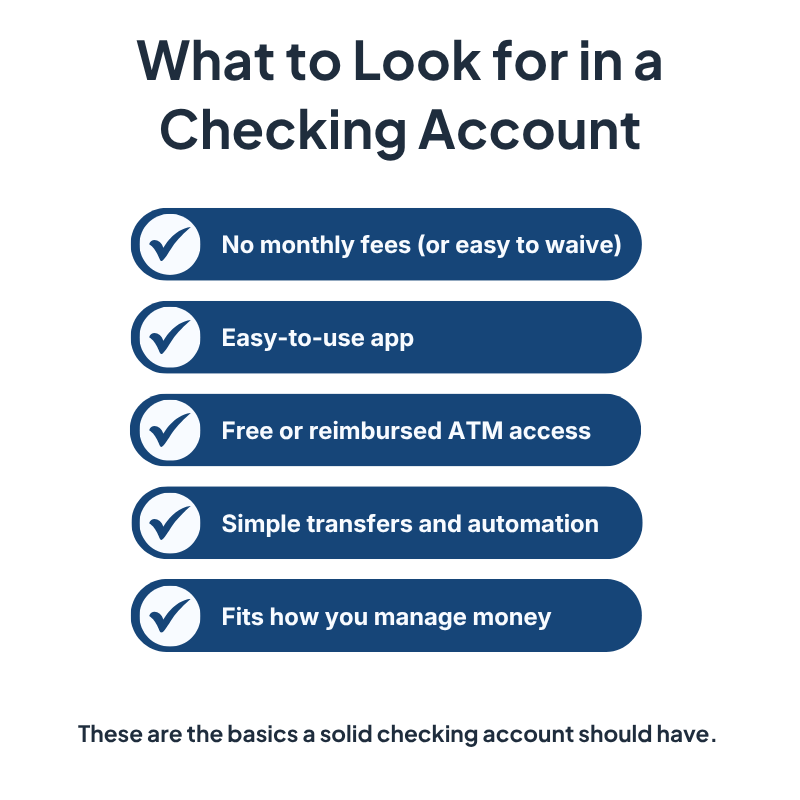
- No monthly fee (or easy to waive) — avoids unnecessary costs over time
- Easy-to-use app — makes managing money simple and fast (this is one of the biggest factors in day-to-day use)
- Free or reimbursed ATM access — reduces withdrawal costs
- Simple transfers and automation — helps keep everything organized
- Fits how you already manage money — reduces friction long term
If you’re comparing a few options, focus on the accounts that meet these basics first, then choose the one that fits your setup best.
Common Checking Account Mistakes to Avoid
Small mistakes when choosing a checking account can lead to ongoing frustration or extra costs. Most come down to focusing on the wrong things upfront.
- Choosing based on brand instead of features — well-known banks don’t always offer the best setup; fees and usability matter more.
- Ignoring fees until they show up — small charges like $10 monthly or $30 overdrafts can add up quickly over time.
- Overvaluing branch access — most day-to-day banking happens online, so app quality usually matters more.
- Using accounts that don’t work well together — disconnected accounts make you constantly move money around.
- Picking an account that doesn’t match your habits — if it doesn’t fit how you manage money, it creates friction over time.
Should You Have More Than One Checking Account?
In many cases, a single checking account is enough for everyday spending. It handles income, bills, and daily transactions without needing additional complexity.
However, adding a savings account or separating certain types of money can make things easier to manage. For example, keeping bills or savings separate can help avoid confusion when your balance looks higher than what’s actually available, which is where many people run into problems.
A simple approach is to start with one account, then add structure only if it improves clarity after a few months of use.
How to Choose a Checking Account You Can Manage Long Term
Read Best Banks to see our top picks.
What to look for in a checking account usually comes down to a few practical things: low fees, reliable access to your money, and a setup that fits how you already manage your finances day to day.
For many people, the best checking accounts are the ones that feel simple and easy to maintain over time. A reliable app, smooth transfers, direct deposit support, and basic automation often have a bigger impact on daily banking than extra features that rarely get used.
If an account makes spending, saving, and paying bills feel easier after the first few weeks, that is usually a good sign the setup fits your banking habits well long term.