What Is an Index Fund?

Some links in this article are affiliate links, meaning we may earn a commission at no extra cost to you.
An index fund is a type of investment fund that tracks a market index like the S&P 500 instead of trying to beat the market through active trading. Rather than picking individual stocks, index funds spread your money across many companies at once, which helps create broad diversification.
Index funds became popular because they offer a lower-cost and easier way to invest long term. For many beginners, they are one of the easiest ways to start investing because they reduce the need to constantly research stocks or manage complicated portfolios.
Understanding how index funds work, their risks, fees, and how people commonly use them can help you decide whether they fit your investing goals.
What Is an Index Fund and How Does It Work?
An index fund is a type of mutual fund or ETF designed to track the performance of a market index like the S&P 500. Instead of trying to outperform the market through active trading, index funds follow the index as closely as possible.
A market index is a group of investments used to represent part of the market. Some indexes track large U.S. companies, while others track broader stock markets, international companies, or bonds.
Common examples include:
- The S&P 500 tracks around 500 large U.S. companies
- The Nasdaq-100 focuses more heavily on technology companies
- Total market indexes track thousands of stocks across the market
Instead of trying to outperform those indexes, an index fund simply follows them.
That means when you buy an index fund, you are usually investing in small pieces of many companies at once.
An S&P 500 index fund, for instance, may include companies like:
- Apple
- Microsoft
- Amazon
- Nvidia
- Hundreds of others
This gives investors broad diversification without needing to buy individual stocks separately.
| Feature | Index Fund |
|---|---|
| Goal | Track a market index |
| Management Style | Passive |
| Investment Type | Many investments together |
| Fees | Usually lower |
| Risk | Depends on the index |
| Maintenance | Minimal |
For many people, index funds make investing feel more manageable because they reduce the need to choose individual stocks themselves.
Read Best Investment Apps to see our top picks.
How Do Index Funds Work?
Index funds work by holding investments that closely match a specific index. Some funds hold nearly every investment in the index, while others use a representative sample to track it closely.
If the index changes, the fund adjusts automatically to stay aligned with it.
For example, if a company is removed from the S&P 500 and another company replaces it, an S&P 500 index fund generally adjusts its holdings to reflect that change.
That is one reason index funds are considered “passive” investments.
Passive investing simply means the fund follows the market instead of trying to constantly outperform it through active trading decisions.
The fund is not trying to constantly predict winning stocks or trade aggressively. It simply follows the index.
That approach usually leads to several advantages:
- Lower operating costs
- Fewer trades
- Simpler management
- Lower fees for investors
Index funds became widely popular after Vanguard founder John Bogle launched the first index mutual fund for individual investors in 1976. His approach focused on keeping investing simple and lowering costs for everyday investors.
For long-term investors, this approach is often easier to stick with because it removes much of the short-term decision-making.
Index Funds vs Mutual Funds: What’s the Difference?
Many index funds are mutual funds, but index funds can also be ETFs. The main difference is not always the fund type — it is whether the fund passively tracks an index or is actively managed.
The main difference is how the investments are managed.
An actively managed mutual fund tries to outperform the market by having fund managers pick investments they believe will perform better than the index.
An index fund does not try to beat the market. It simply tracks it.
| Feature | Index Funds | Actively Managed Funds |
|---|---|---|
| Goal | Match market performance | Beat market performance |
| Management | Passive | Active |
| Fees | Lower | Higher |
| Trading Activity | Lower | Higher |
| Long-Term Simplicity | Usually easier | Often more complex |
Higher fees do not automatically lead to better returns. In many cases, actively managed funds struggle to outperform broad index funds consistently over long periods once fees are factored in.
That is one reason many long-term investors prefer simple index investing strategies.
Index Funds vs ETFs: Which Is Better for Beginners?
People often confuse index funds and ETFs because many ETFs are also index-based investments.
The difference mostly comes down to how they are traded.
- Index mutual funds are bought or sold once per day after the market closes
- ETFs trade throughout the day like stocks
Both can track the exact same index.
For example, two different funds may both follow the S&P 500 even though one is an ETF and the other is a mutual fund.
| Feature | Index Mutual Fund | ETF |
|---|---|---|
| Trades During Day | No | Yes |
| Bought Like a Stock | No | Yes |
| Minimum Investment | Sometimes higher | Often flexible |
| Automatic Investing | Usually easier | Varies by platform |
For long-term investors, the differences are usually smaller than many people expect. Many people simply choose whichever option works best with their brokerage account and investing habits.
If you are still learning the basics, it also helps to understand the different types of investment accounts before choosing investments.
Why Are Index Funds So Popular?
Index funds became popular because they simplified investing for ordinary investors.
Instead of researching dozens of individual companies, investors could buy broad market exposure in one investment.
That helped solve several common investing problems:
- Diversification became easier
- Fees became lower
- Investing required less maintenance
- Long-term investing became more accessible
For many people, index funds also reduce emotional decision-making around investing.
Constantly buying and selling individual stocks can become stressful, especially during market swings. A broader index approach tends to feel more stable because your money is spread across many investments instead of relying heavily on one company.
Over long periods, broad-market index funds have also performed well compared to many actively managed funds.
One reason many investors stick with index funds long term is that the strategy removes a lot of daily decision-making. Instead of always trying to pick winning stocks, the focus becomes staying consistent and continuing to invest over time.
Types of Index Funds Explained
Not all index funds track the same type of investments.
Some focus on the entire market, while others focus on specific sectors, company sizes, or international markets.
Common types of index funds include:
S&P 500 Index Funds
S&P 500 index funds track around 500 of the largest publicly traded U.S. companies and are some of the most widely used long-term investing funds. Because they focus on large established companies across multiple industries, many investors use them as a core investment for retirement and long-term growth.
Total Market Index Funds
Total market index funds track thousands of companies across the U.S. stock market instead of focusing only on large companies. These funds usually include a mix of large-, mid-, and small-cap stocks, which gives investors broader market exposure in a single fund.
International Index Funds
International index funds focus on companies outside the United States. Some track developed international markets, while others include emerging markets as well. Investors often use these funds to add geographic diversification alongside U.S. investments.
Bond Index Funds
Bond index funds track collections of bonds instead of stocks and are often used to reduce portfolio volatility. Depending on the fund, they may include government bonds, corporate bonds, or a mix of different bond types.
Sector Index Funds
Sector index funds focus on specific industries rather than the broader market.
Common sectors include:
- Technology
- Healthcare
- Energy
- Real estate
Sector funds can sometimes grow faster during strong market periods for that industry, but they are usually more volatile because they are less diversified than broader market funds.nds.
Popular Index Fund Examples for Beginners
Many index funds track similar indexes, but different companies offer their own versions.
Here are a few well-known examples:
| Fund | Tracks | Type |
|---|---|---|
| VOO | S&P 500 | ETF |
| VTI | Total U.S. Market | ETF |
| FXAIX | S&P 500 | Mutual Fund |
| VTSAX | Total U.S. Market | Mutual Fund |
Some investors prefer S&P 500 funds because they focus on large established U.S. companies, while others prefer total-market funds because they include both large and smaller companies across the market. In practice, both are commonly used for retirement accounts and long-range investing goals.
When comparing index funds, many long-term investors usually focus on a few core things:
- Broad diversification
- Low fees
- Consistency
- Simplicity
In many cases, those factors matter more than trying to find the “perfect” fund.
Benefits and Drawbacks of Index Funds
One reason index funds became so popular is that they make investing easier while still providing broad diversification.
Benefits of Index Funds
Diversification
Owning many investments together reduces the risk of relying too heavily on one company.
Lower Fees
Because index funds require less active management, expenses are usually lower.
Most index funds charge something called an expense ratio, which is an annual fund fee built into the investment. Expense ratios vary by fund, but many broad-market index funds charge relatively low fees compared to many actively managed funds.
For example, many broad-market index funds now charge expense ratios well below 0.10%, while some actively managed funds may charge closer to 0.50%–1.00% or more. Over decades, even small fee differences can noticeably affect long-term returns.
Small investing fees may not seem important at first, but over long periods they can noticeably reduce investment growth.
Simpler Long-Term Investing
Index funds remove much of the complexity involved in choosing and managing individual stocks. Many investors use them long term because they are easier to manage and work well with automatic investing plans through retirement accounts and brokerage platforms.
Many platforms also allow automatic weekly or monthly contributions, which can make investing easier to stay consistent with over time.
Drawbacks of Index Funds
Index funds are still investments, which means they can lose value.
A diversified fund may reduce some company-specific risk, but it does not remove overall market risk.
Some common drawbacks include:
- Market downturns can still affect performance
- Some funds are heavily concentrated in certain sectors
- International funds may carry currency or geopolitical risks
- Short-term volatility can still be stressful during market declines
Because of that, stock index funds are usually better suited for long-term investing rather than short-term money needs.
The level of risk also depends heavily on the type of index fund. A broad total-market fund behaves very differently from a narrow technology-sector fund.
Are Index Funds Safe?
Index funds can reduce single-company risk compared to owning only a few individual stocks because they spread investments across many companies.
However, they are still investments, which means their value can rise and fall with the market.
If the overall stock market declines, broad index funds usually decline as well. During major market downturns, stock index funds can temporarily lose significant value before recovering over longer periods.
Market drops are normal with long-term investing. The bigger risk for many investors is reacting emotionally and selling during short-term declines.
It is also important to understand that index funds are not FDIC-insured like bank accounts. Their value can fluctuate over time.
For many long-term investors, one advantage is that broad-market index funds have historically recovered over time after major downturns, though future results are never guaranteed.
For many investors, the hardest part is not choosing an index fund — it is staying invested when markets drop and avoiding emotional decisions during short-term swings.
How Investors Commonly Use Index Funds
Index funds are often used as core long-term investments.
Common uses include:
- Retirement investing
- Roth IRA investing
- 401(k) investing
- Long-term wealth building
- College savings
- General brokerage investing
In practice, many retirement accounts already include index funds through 401(k) plans, target-date funds, or retirement portfolios managed by brokerage platforms.
Many simple portfolios are built around just a few broad index funds.
For example, some investors use:
- One total U.S. market fund
- One international fund
- One bond fund
Others keep things even simpler with a single all-in-one target-date or total-market fund.
A lot of long-term investors eventually prefer simpler portfolios because they are easier to manage and require less attention over time.
The “best” setup usually depends more on time horizon, risk tolerance, and consistency than trying to constantly find the perfect fund.
How to Invest in Index Funds
Read: How to Start Investing
Getting started with index funds is usually easier than many people expect.
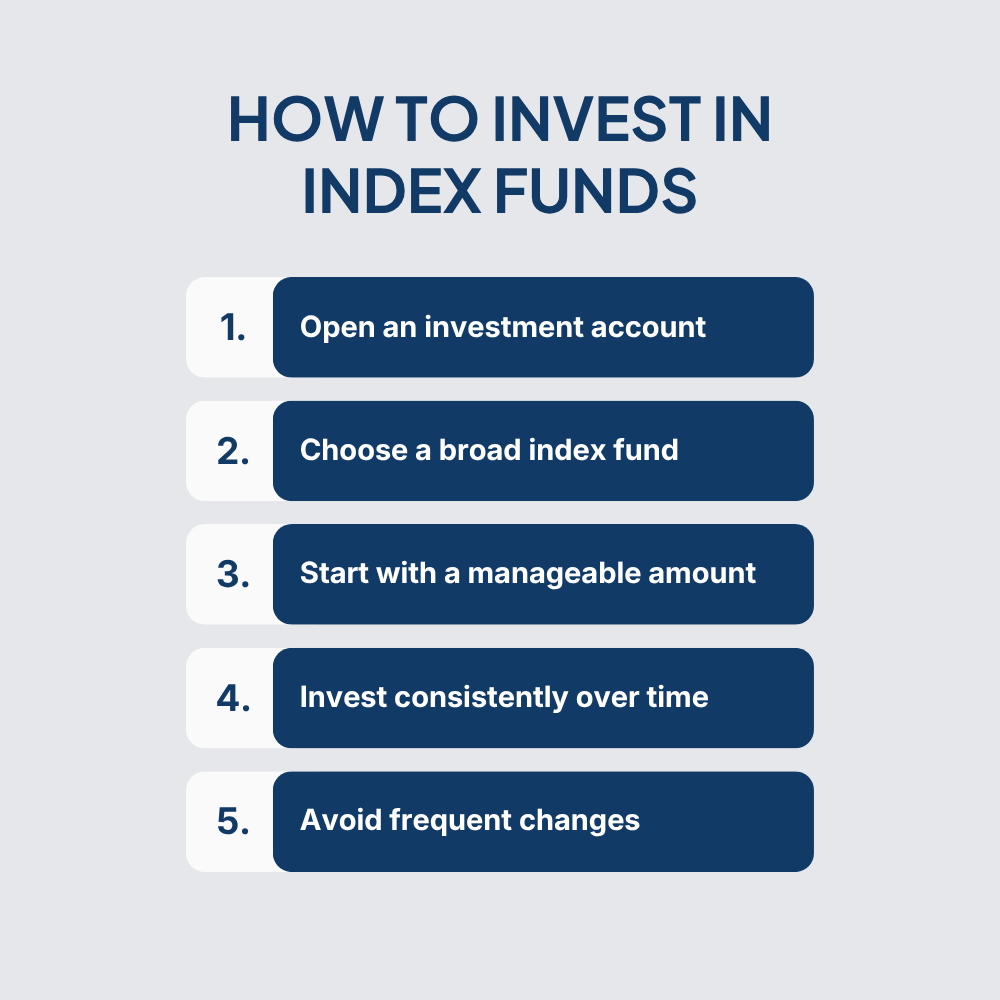
For most people, the process looks something like this:
- Open an investment account
This may be a brokerage account, Roth IRA, traditional IRA, or workplace retirement account. - Choose a broad index fund
Many beginners start with broad-market funds that track the S&P 500 or total U.S. stock market.
Broad-market funds are often popular because they spread investments across hundreds or thousands of companies instead of relying heavily on a small number of stocks.
Many investors start with total-market or S&P 500 funds because they provide diversification across many companies instead of concentrating heavily on one stock or industry.
- Start with a manageable amount
You do not need a huge balance to begin investing. Many brokerages allow small recurring contributions, though minimums and fractional investing options vary by platform and fund. - Invest consistently over time
Long-term consistency usually matters more than trying to perfectly time the market.
Some investors contribute automatically every paycheck or once per month so investing happens consistently without overthinking market timing.
Consistency usually matters more than trying to buy at the “perfect” moment. Many investors spend so much time waiting for better market conditions that they delay getting started altogether.
- Avoid constantly changing investments
Many long-term investors keep their investing approach relatively simple.
For many people, the hardest part is simply getting started and staying consistent during market ups and downs.
If you are building your first investing setup, it also helps to understand how to start investing and choose the right type of investment account first.
Are Index Funds Good Investments for Beginners?
For many beginners, index funds are one of the easiest ways to start investing because they simplify diversification and reduce the need to constantly research individual stocks.
For example, a single broad-market index fund can provide exposure to hundreds or even thousands of companies in one investment, which would be difficult for most beginners to build on their own.
That does not mean index funds are risk-free, but they are often easier to manage compared to more complex investing strategies.
Index funds also help many beginners avoid several common investing mistakes:
- Overtrading
- Chasing hype stocks
- Trying to time the market
- Constantly switching investments
Many people find simple index fund portfolios easier to stick with long term because there is less pressure to monitor markets or constantly search for winning stocks.
Many beginners assume investing requires constant stock research, but long-term investing is often more about consistency than complexity.
If you are starting from scratch, it can also help to learn how to start investing before choosing investments.
Common Index Fund Investing Mistakes to Avoid
Index funds are simple, but people can still make investing mistakes around them.
Focusing Only on Recent Performance
Funds that performed well recently do not always continue outperforming. Chasing recent returns often leads to buying after prices already climbed.
Taking Too Much Risk
Some index funds are heavily concentrated in one sector or country. Not every index fund is automatically diversified enough for every situation.
Ignoring Fees Completely
Most index funds are low-cost, but fees still vary between providers. Some broad-market index funds charge only a few dollars annually for every $10,000 invested, while higher-cost funds may charge significantly more over time.
Over long periods, lower expenses can make a noticeable difference because fees reduce returns every year the investment is held.
Constantly Changing Investments
Switching funds repeatedly can make investing more complicated and emotional. Long-term consistency is often more important than frequently changing investments.
Investing Money Needed Soon
Stock index funds are usually better suited for long-term goals because markets can fluctuate significantly in the short term.
Index Fund FAQs
Are index funds safe?
Index funds are generally considered lower-risk than owning a few individual stocks, but they still carry market risk. Their safety depends largely on the investments inside the fund and how long you plan to stay invested.
Do index funds pay dividends?
Many index funds distribute dividends because the underlying companies inside the fund pay dividends.
Can you lose money in index funds?
Yes. Index funds can lose value during market declines, especially over shorter periods.
Are index funds good for retirement investing?
For many people, index funds work well for retirement investing because they offer diversification, simplicity, and long-term growth potential.
How much money do you need to start investing in index funds?
Many brokerages now allow investors to start with very small amounts of money, especially when buying ETFs or using recurring investments. In many cases, consistency matters more than starting with a large balance.
What is the average return of an index fund?
Returns vary depending on the type of index fund, fees, and market conditions. Broad U.S. stock index funds have historically produced positive returns over long periods, but yearly performance can fluctuate significantly and future returns are not guaranteed.
Long-term averages are often discussed over periods of 10 years or more because short-term returns can vary widely from year to year.
What is the difference between an index fund and a stock?
A stock represents ownership in one company. An index fund usually holds many investments together inside one fund.
Should You Invest in Index Funds?
Read Best Investment Apps to see our top picks.
Index funds became popular because they made investing easier to manage without requiring constant stock picking or hands-on trading.
For many people, they provide a practical balance of diversification, lower fees, and long-term growth potential. They also remove much of the complexity that causes investing to feel overwhelming in the beginning.
The goal is not necessarily to find a “perfect” investment or constantly chase the best-performing fund. In many cases, building a simple investing system that you can consistently stick with matters far more over time.
If you want to build a simple investing setup around long-term goals, our guide on how to start investing breaks down the basics of accounts, risk, and getting started.