Why Most Budgets Fail

Some links in this article are affiliate links, meaning we may earn a commission at no extra cost to you.
Most budgets fail because they rely on unrealistic spending rules, too much daily effort, or systems that are difficult to maintain once normal life gets busy.
Many people start budgeting with good intentions, but the process quickly becomes frustrating. Categories feel too strict, tracking takes too much effort, or the budget depends on habits that are difficult to maintain long term.
The best budgets usually feel simple, flexible, and realistic enough to continue using after the early motivation fades. In most cases, consistency matters far more than building a “perfect” budget from the start.
The Biggest Reasons Budgets Fail
A budget usually fails long before the numbers themselves become the problem. Most issues come from how the budget is built and how difficult it feels to maintain over time.
A lot of budgeting systems look good at first, but become exhausting once real life starts getting involved.
The most common reasons budgets fail include:
- Budgets that are too restrictive
- Tracking systems that take too much effort
- Unrealistic spending expectations
- Trying to change every habit at once
- Using a budgeting style that does not fit your personality
- Treating mistakes like failure
In many cases, budgeting problems are less about discipline and more about building a system that feels manageable month after month.
| Common Problem | What Usually Happens |
|---|---|
| Overly strict categories | Spending rebounds later |
| Complicated tracking | People stop checking the budget |
| Unrealistic goals | Budget feels impossible to maintain |
| Too many accounts/apps | Budget becomes hard to manage |
| No flexibility | Small mistakes derail the entire plan |
Most successful budgets are usually simpler than people expect. They focus more on consistency and awareness than trying to control every dollar perfectly.
Many budgeting problems are connected. Restrictive rules often lead to burnout, overly detailed tracking creates frustration, and unrealistic expectations make the system harder to maintain once life becomes unpredictable.
Most long-term budgeting success comes from reducing friction instead of trying to control every spending decision perfectly.
Read Best Budgeting Apps to see our top picks.
Budgets Often Feel Too Restrictive
One of the fastest ways to fail a budget is trying to cut out every enjoyable expense immediately.
Many budgets are built around “ideal” spending instead of realistic spending. That usually creates a cycle where people follow the budget for a few weeks, feel deprived, then overspend once the restrictions become frustrating.
This is especially common with:
- Extremely low food budgets
- Zero entertainment spending
- Unrealistic shopping limits
- Aggressive debt payoff plans
- Strict daily spending caps
A budget should create structure, not make everyday life feel miserable.
For example, someone who normally spends $500 per month eating out will probably struggle with a sudden $50 restaurant budget. The same thing often happens with grocery budgets that look reasonable on paper but become frustrating after a few busy weeks of takeout, convenience spending, or higher food prices. In many cases, reducing spending gradually by even $100–$150 per month tends to feel far more sustainable than making extreme cuts immediately.
Smaller adjustments usually work better because they feel realistic enough to maintain long term.
In a lot of cases, budgets fail because they are designed around short-term motivation instead of long-term behavior.
Tracking Every Dollar Gets Exhausting
Detailed budgeting sounds good in theory, but too much tracking often becomes difficult to maintain consistently.
Many people start with highly detailed spreadsheets, dozens of categories, or manual expense tracking systems that take constant attention. After a few weeks, the process starts feeling more like homework than a helpful system. This is especially common when every purchase needs to be categorized manually or checked multiple times per week.
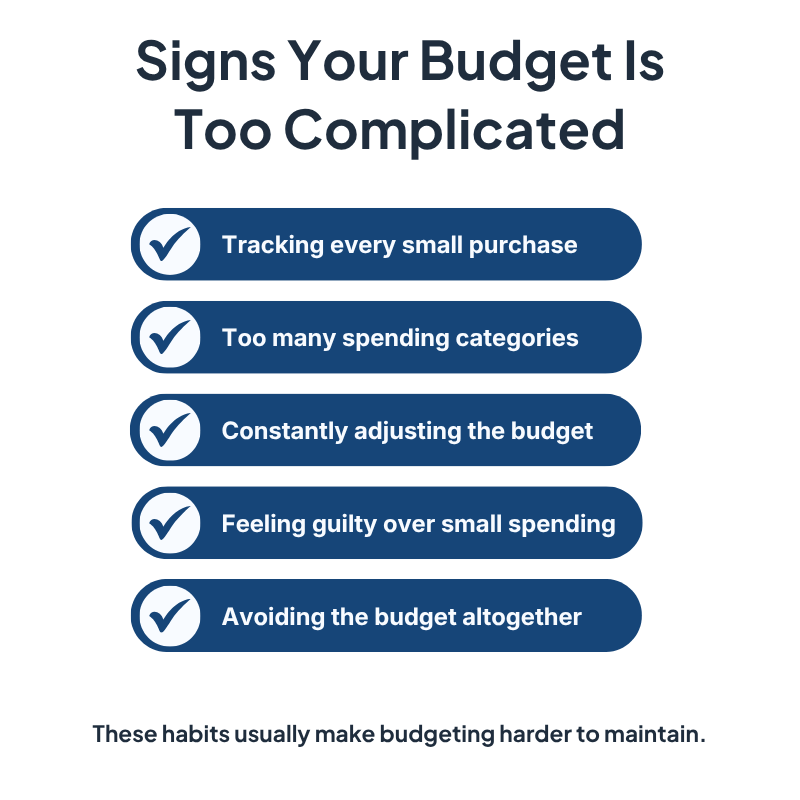
Common signs a budget is becoming too complicated include:
- Constantly recategorizing transactions
- Checking the budget multiple times per day
- Forgetting to update spending
- Feeling guilty over small purchases
- Avoiding the budget altogether
The more work a budget requires, the harder it usually becomes to stick with long term.
For a lot of people, simpler systems work better because they reduce friction and make budgeting easier to maintain consistently. If detailed tracking has never worked well for you, it may help to start with a simpler budgeting approach before moving into more advanced systems.
This is one reason many people quit detailed spreadsheet budgets after a month or two. The system itself becomes harder to maintain than the financial problems it was supposed to solve.
If you are comparing different approaches, it can also help to understand how the 50/30/20 budget rule works since many people find it easier to maintain than highly detailed budgeting systems.
A budget that takes 30–60 minutes to maintain every week usually becomes harder to stick with once life gets busy. Simpler systems tend to last longer because they require less daily attention.
Most People Underestimate Irregular Expenses
One reason budgets fall apart quickly is because people often plan only for predictable monthly bills while forgetting about irregular spending.
Expenses like:
- Car repairs
- Holidays and gifts
- Annual subscriptions
- Medical bills
- School expenses
- Travel
- Pet costs
These can completely disrupt a budget if there is no room planned for them.
This is one reason budgets may feel like they are “failing” even when the real issue is simply incomplete planning.
For example, someone may stay within budget for several months, then suddenly overspend because of a large car repair bill or a heavy holiday shopping month. Without separate savings or flexible categories, the entire budget can start feeling broken even when the issue is simply an unexpected expense.
Annual subscriptions are another common issue. Streaming services, software renewals, warehouse memberships, and yearly insurance payments are easy to forget when building a monthly budget. Even smaller recurring charges in the $10–$30 range can quietly add up once multiple subscriptions renew around the same time.
A stronger setup usually includes some buffer room for unexpected or inconsistent expenses instead of assuming every month will look identical.
Budgeting Motivation Often Fades Over Time
A lot of budgeting systems depend too heavily on motivation.
At the beginning, tracking spending and cutting expenses often feels exciting because progress happens quickly. But after a few weeks, the excitement usually fades and the system starts feeling repetitive.
That is when complicated budgets often collapse.
The people who stick with budgeting long term are usually not the most motivated — they are the ones using systems that still feel manageable during busy or stressful months. Simpler systems often survive periods where work schedules, family responsibilities, or unexpected expenses temporarily disrupt routines.
This is why automation tends to help so much over time.
Helpful automation can include:
- Automatic savings transfers
- Recurring bill payments
- Direct deposit splits
- Spending alerts
- Automatic investing contributions
These tools reduce the amount of daily effort required to stay organized.
For example, automatically moving money into savings right after payday often works better than relying on leftover money at the end of the month. Removing small decisions from the process can make budgeting feel easier to maintain because less day-to-day effort is required.
In many cases, the best budget is the one that requires the least amount of constant decision-making.
Budgeting Styles Do Not Work the Same for Everyone
A budgeting method that works well for one person may feel frustrating for someone else.
Some people like detailed category tracking, while others prefer broader spending guidelines. Problems usually happen when someone forces themselves into a budgeting style that does not match how they naturally manage money.
Here is a simple comparison of common budgeting styles:
| Budgeting Style | Usually Works Best For |
|---|---|
| 50/30/20 Budget | Simple budgeting with flexibility |
| Zero-Based Budget | Highly detailed spending control |
| Cash Envelope System | Reducing overspending habits |
| Pay Yourself First | Savings-focused budgeting |
| App-Based Budgeting | Automated tracking and organization |
A lot of people fail budgeting because they assume there is only one “correct” way to do it.
For example, someone who dislikes spreadsheets will probably struggle with a highly detailed manual budget even if the math itself works perfectly. On the other hand, someone who enjoys tracking numbers closely may feel uncomfortable using a broad budgeting system with fewer categories.
The better approach is usually choosing a system that feels easy enough to stick with consistently.
If you are still figuring out what fits your habits best, it can help to compare different budgeting methods before committing to one setup long term.
Emotional Spending Can Quietly Break a Budget
A budget is not just a math problem. Spending habits are heavily tied to stress, boredom, convenience, habits, and emotions.
This is one reason even well-designed budgets sometimes fail.
Common triggers include:
- Stress spending
- Impulse purchases
- Convenience spending
- Social pressure
- Emotional reward spending
- “I already messed up” spending
Most people already know roughly where their money should go. The harder part is making good decisions consistently when emotions get involved.
For example, someone may stay on budget all week, then overspend after a stressful day because the purchase feels emotionally justified in the moment. Smaller impulse purchases can also add up quickly over time, especially with online shopping, subscription services, and fast checkout systems.
This is also why extremely strict budgets often backfire. The more restrictive the system feels, the easier it becomes to overspend impulsively later.
Many people do not fail budgeting because they are “bad with money.” The budget itself often fails because it depends on perfect habits that are difficult to maintain consistently.
A realistic budget usually leaves some room for normal human behavior instead of expecting perfect financial decisions all the time.
Budgets Often Fail When Income Changes
A lot of budgets are built around stable monthly income, but real life does not always work that way.
Income changes from:
- Overtime fluctuations
- Commission pay
- Freelance work
- Seasonal income
- Reduced work hours
- Unexpected expenses
These can make highly fixed budgets difficult to maintain.
For example, someone may create a budget during a strong income month, then struggle once overtime disappears or extra expenses show up. This often makes the budget feel broken even though the real issue is that the plan was too rigid for variable income.
Flexible budgeting usually works better when income changes regularly. Many people with variable income find it easier to budget using average monthly income ranges instead of trying to predict every paycheck perfectly.
This is one reason broader budgeting systems often feel easier to maintain than highly detailed category-based budgets. They give spending more room to adjust during lower-income months without requiring a complete reset every time income changes.
What Sustainable Budgets Usually Look Like
Most successful budgets are not highly detailed systems built around perfect spending behavior.
Most sustainable budgets are designed to survive imperfect months.
People still overspend occasionally, forget expenses, or run into unexpected situations. The difference is that stronger budgeting systems can recover from those mistakes without completely falling apart.
A budget that works only during “perfect” months usually becomes difficult to maintain long term.
In practice, sustainable budgets are usually:
- Flexible instead of overly strict
- Simple enough to maintain consistently
- Built around real spending habits
- Automated where possible
- Focused on long-term consistency
- Able to handle mistakes without collapsing
| Unsustainable Budget | Sustainable Budget |
|---|---|
| Tracks every small purchase | Focuses on major spending habits |
| Depends on motivation | Uses automation and routines |
| Has extremely strict categories | Allows flexibility |
| Requires constant updates | Feels manageable week to week |
| Breaks after mistakes | Adjusts and continues |
Most people do better with budgeting once the goal shifts from “perfect control” to “consistent awareness.”
A workable budget should feel supportive — not exhausting.
Budget Apps Can Help — But They Do Not Fix Everything
Budgeting apps can make budgeting easier, but they do not automatically fix spending habits on their own.
The biggest advantage of budgeting apps is usually visibility and organization. Seeing spending clearly often improves decisions naturally without needing constant manual tracking.
Good budgeting apps can help with:
- Automatic transaction tracking
- Spending awareness
- Shared household budgeting
- Savings goals
- Recurring expense monitoring
- Simpler organization
But even strong apps still require realistic expectations and consistent use.
Budgeting apps can help by improving organization, visibility, and automation. However, an app alone usually does not change spending habits without consistent use and realistic budgeting expectations. Simpler apps are often easier for people to maintain over time because they require less manual effort.
For example, someone who rarely checks financial apps may do better with a simple automated budgeting app than a highly customizable system that requires constant manual updates. Budgeting tools usually work best when they reduce effort instead of creating even more financial tasks to manage every day.
Simple Ways to Make a Budget Easier to Stick With
If budgeting has failed before, the solution is usually simplifying the system rather than adding more complexity.
A few smaller adjustments often make a bigger difference than rebuilding everything from scratch.
| Budget Habit That Often Fails | Habit That Usually Lasts Longer |
|---|---|
| Tracking every purchase manually | Automating key parts of the budget |
| Extreme spending cuts | Gradual spending adjustments |
| Constant budget changes | Simple consistent categories |
| Trying to budget perfectly | Focusing on overall progress |
| Relying on motivation | Building routines and systems |
Start With Fewer Categories
Too many categories make budgeting harder to maintain.
Broad categories like:
- Bills
- Savings
- Food
- Spending
- Transportation
These are often easier to manage than highly detailed systems with 25–40 separate spending categories.
Build in Flexibility
Budgets work better when small mistakes do not ruin the entire month.
Leaving extra room for unexpected spending helps reduce the “all-or-nothing” mindset that causes many budgets to collapse after a bad week.
Automate the Important Parts
Automation reduces the amount of effort required to stay organized consistently.
Even small automations like automatic savings transfers or recurring bill payments can remove a lot of budgeting stress over time. For example, automatically moving even $25–$100 into savings after each paycheck can help build consistency without requiring constant attention.
Focus on Awareness First
Many people improve their finances simply by becoming more aware of where their money is going.
You do not need a perfect budget immediately. In a lot of cases, consistent awareness creates better spending decisions naturally over time.
If you are just getting started, it can help to learn how to start a budget with a simpler setup before trying more advanced budgeting systems.
The best budget is usually not the most detailed one. It is the one that still works during stressful months, busy schedules, and unexpected expenses.
Why Most Budgets Fail FAQ
Why do most budgets fail?
Most budgets fail because they are too restrictive, too complicated, or unrealistic to maintain long term. Budgets usually work better when they are simple, flexible, and built around real spending habits instead of idealized ones.
Is budgeting supposed to feel restrictive?
A budget should create structure, but it should not feel impossible to live with. Extremely restrictive budgets often lead to frustration and overspending later because they are difficult to maintain consistently.
What is the easiest budgeting method to stick with?
For many people, simpler budgeting methods like the 50/30/20 budget work well because they focus on broader spending categories instead of highly detailed tracking. The best budgeting system is usually the one that feels realistic and manageable long term.
Do budgeting apps actually help?
Budgeting apps can help by improving organization, visibility, and automation. However, the app itself does not solve spending habits automatically. Simpler apps are often easier to maintain consistently over time.
Why do I always quit budgeting?
Many people quit budgeting because the system feels too restrictive or takes too much daily effort to maintain. Budgets usually become easier to maintain when they are simplified, automated where possible, and built around realistic spending habits instead of perfect behavior.
How long does it take for budgeting to feel normal?
For most people, budgeting feels awkward at first because spending habits are changing. After a few months, the process usually becomes easier once categories, routines, and automation settle into place. In many cases, the first 30–90 days are the hardest because that is when spending habits and routines are still adjusting.
Why Most Budgets Fail — And What Usually Works Better
Read Best Budgeting Apps to see our top picks.
Most budgets fail because they ask people to change too much too quickly while relying on systems that are difficult to maintain long term.
The budgets that usually last are the ones that feel realistic enough to maintain during normal life — not just during periods of high motivation.
For many people, budgeting becomes easier once the focus shifts toward simplicity, flexibility, and consistent habits instead of trying to control every dollar perfectly.
If you want a simpler starting point, our guide to the 50/30/20 budget rule breaks down one of the easiest budgeting systems for reducing budgeting overwhelm while still keeping spending, saving, and financial goals organized.