Are Online Banks Safe?

Some links in this article are affiliate links, meaning we may earn a commission at no extra cost to you.
Are online banks safe? In most cases, yes—if the bank is FDIC-insured and operated by a legitimate financial institution. Most online banks use the same protections as traditional banks, including FDIC insurance, encryption, fraud monitoring, and multi-factor authentication.
The biggest risks usually come from phishing scams, fake apps, weak passwords, or financial platforms that are not actually banks. Once you understand how online banks protect your money and what to verify before opening an account, they’re generally just as safe as traditional banks for everyday banking.
Read Best Online Banks to see our top picks.
Are Online Banks Actually Safe?
Yes, most online banks are safe if they are FDIC-insured and operated by legitimate financial institutions. Today, many people manage most of their banking through apps and websites—even when using traditional banks.
Many online-only banks now handle direct deposit, savings, bill payments, and transfers entirely through apps and websites. The lack of physical branches can make them feel less secure at first, but branches themselves are not what protect your money.
Federal insurance and banking security systems are what matter most. For most people who already manage money primarily through their phone, the day-to-day experience usually feels very similar to using a traditional bank app—except online banks often offer lower fees and more competitive savings rates.
Online banks are usually just as safe as traditional banks if they’re FDIC-insured and operated by legitimate financial institutions.
What we found is that people often confuse “online banks” with random financial apps or startups. A legitimate online bank still operates within the same banking system as traditional institutions.
The main difference is how the banking experience is delivered—not whether your deposits are protected.
| Feature | Online Banks | Traditional Banks |
|---|---|---|
| FDIC Insurance | Yes | Yes |
| Fraud Monitoring | Yes | Yes |
| Mobile Banking Security | Yes | Yes |
| Physical Branches | Usually No | Yes |
| Account Alerts | Yes | Yes |
If you’re still comparing how online-only banking differs from branch banking, it also helps to understand the differences between online banks vs traditional banks before choosing an account setup.
Why Online Banks Are Usually Safe
Online banks are generally safe because they use the same core protections as traditional banks. In most cases, the underlying banking infrastructure is extremely similar—the experience is just delivered through apps and websites instead of branches.
FDIC Insurance Protects Your Deposits
FDIC insurance is one of the main reasons online banks are considered safe. If a bank is FDIC-insured, deposits are typically protected up to $250,000 per depositor, per FDIC-insured bank, per ownership category if the institution fails.
This protection applies whether the bank operates online, through branches, or both. The insurance is tied to the institution itself—not the building.
Many online banks clearly display their FDIC membership information on their website or app. Some financial apps and fintech platforms also provide FDIC insurance through partner banks, which is why checking the actual banking partner matters.
In most cases, FDIC insurance matters more than whether a bank has physical locations nearby. A branch may feel reassuring, but it does not provide additional deposit protection beyond what insured banks already offer. This becomes especially important when comparing a well-known online bank to a traditional bank with higher fees or weaker savings rates.
What Happens if an Online Bank Fails?
If an FDIC-insured online bank fails, insured deposits are generally protected up to applicable limits. In many cases, the FDIC either transfers insured deposits to another FDIC-insured institution or makes insured funds available through its resolution process.
This is important because many people assume an online bank disappearing means their money disappears with it. That is typically not how regulated banks operate.
Bank failures are relatively uncommon, but when they do happen, the system is designed to protect insured customer deposits rather than leave account holders without access to funds.
Online Banks Use the Same Security Systems as Traditional Banks
Most online banks use the same core security systems as traditional banks. This usually includes encryption, multi-factor authentication, fraud monitoring systems, account alerts, and suspicious login detection.
Many online banks place a heavy focus on digital security because their entire experience depends on app and account protection.
For example, many online banks send instant notifications for purchases, transfers, password changes, and login attempts within seconds or minutes of activity. Some also allow users to freeze cards instantly inside the app, which can reduce fraud exposure if something looks suspicious.
In reality, the overall security difference between online and traditional banks is usually smaller than people expect.
Many Online Banks Are Major Financial Institutions
Online banking is no longer limited to small startups or unfamiliar apps. Well-known online or online-focused banking options such as SoFi, Ally Bank, Capital One, and Discover all operate heavily through apps and websites.
The banking industry has largely shifted toward digital banking regardless of whether branches still exist.
For most people, the deciding factor is whether they need in-person services like cash deposits or face-to-face support. Someone who mainly uses direct deposit, transfers money digitally, and rarely visits branches will often notice very little practical difference after switching to an online bank.
Branch access is generally the main operational difference—not the level of security protection.
The Real Risks of Online Banking
The biggest risks with online banking usually come from scams, poor security habits, or confusion about what qualifies as a real bank.
Understanding these risks gives a much clearer picture than assuming online banking itself is dangerous.
Important: Most online banking problems come from scams, fake apps, or weak passwords—not the bank itself.
Fake Banking Apps and Scam Websites
Fake apps and phishing websites are some of the biggest online banking risks today. These scams are designed to steal login information or gain account access.
Common examples include:
- fake login pages
- text message links
- fraudulent emails
- unofficial mobile apps
In most cases, legitimate banks do not randomly request passwords, verification codes, or account access through email or text links.
Downloading apps directly from official app stores and verifying website URLs before logging in reduces a large portion of this risk. Small differences in spelling, branding, or website addresses are often warning signs.
Weak Passwords and Unsafe Habits
Most online banking security problems start with weak account habits rather than flaws in the bank itself.
Common examples include:
- reusing passwords across accounts
- ignoring fraud alerts
- logging in on unsecured public Wi-Fi
- disabling two-factor authentication
- sharing passwords across devices
In many cases, convenience habits create more risk than the online bank itself. A strong password and multi-factor authentication often matter more than whether a bank has physical branches.
In practice, most online banking security problems start with compromised logins rather than failures inside the banking system itself.
Online banking security is partly shared responsibility. Banks provide security systems, but users still control account access behaviors.
Not Every Financial App Is Actually a Bank
A common point of confusion is the difference between online banks, fintech companies, and payment apps.
| Online Bank | Financial App |
|---|---|
| FDIC-insured directly | May rely on partner banks |
| Holds deposits directly | Often acts as intermediary |
| Banking charter | Usually no banking charter |
Some financial apps offer banking-like features without being actual banks themselves. Instead, they may partner with FDIC-insured institutions to hold deposits behind the scenes, but pass-through FDIC coverage depends on whether the funds are actually placed at an insured bank and whether the required conditions are met.
That does not automatically make them unsafe, but it does mean users should understand where their money is actually held and how insurance coverage works.
This matters most for people using budgeting apps, payment platforms, or newer fintech apps that advertise banking-style features without operating as full banks themselves.
Checking the underlying banking partner is one of the simplest ways to evaluate whether a financial platform operates legitimately.
How to Tell if an Online Bank Is Legit
A legitimate online bank is usually easy to verify once you know what to look for. Most trustworthy institutions are transparent about insurance coverage, security practices, and customer support.
What to Check Before Opening an Account
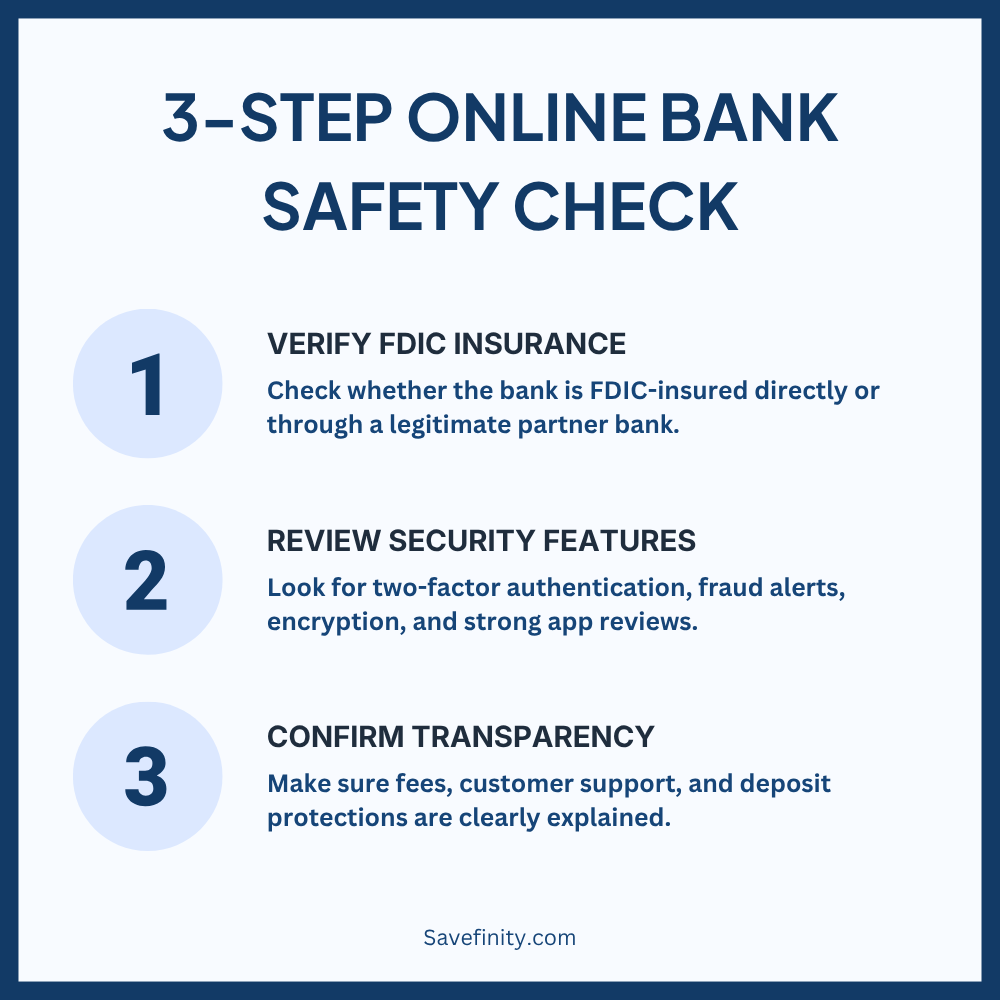
Before opening an online bank account, look for:
- FDIC insurance information
- clear company and contact information
- transparent fee disclosures (especially monthly fees, overdraft fees, and ATM fees)
- strong app security features
- customer support access
- established reputation and reviews
Legitimate banks typically make this information easy to find. If basic details about insurance or account protection are difficult to verify, that is usually a warning sign. Established banks are usually transparent about how deposits are protected because trust is a major part of banking.
In many cases, a well-established online bank will also explain how deposits are protected and how fraud issues are handled.
How to Verify FDIC Insurance
One of the easiest ways to verify a bank is through the FDIC BankFind tool. This allows users to confirm whether an institution is officially insured.
It also helps to:
- review banking disclosures
- verify partner banks for fintech apps
- confirm that insurance information matches across the website and app
This matters because some financial apps advertise banking features without clearly explaining how deposits are actually protected.
Checking the underlying institution adds an extra layer of confidence before moving money into an account.
Warning Signs to Avoid
Several warning signs can indicate that a financial platform deserves additional caution.
These include:
- unrealistic promises or guaranteed returns
- vague or missing insurance information
- unclear fee structures
- poor customer support
- limited transparency about where deposits are held
Legitimate banks generally explain their protections clearly because trust is a core part of banking.
If basic questions about security or deposit protection are difficult to answer, that can be a warning sign.
Are Online Banks Safer Than Traditional Banks?
Read Best Banks to see our top picks.
Online banks are not inherently safer or less safe than traditional banks. In practice, safety usually depends more on the institution itself and how accounts are managed.
Online banks can sometimes improve security because they often prioritize digital controls and instant notifications. Features like real-time fraud alerts, instant card freezes, and app-based security settings can help users spot suspicious activity quickly. For people who actively monitor spending through their phone, these tools can make fraud easier to catch early.
Traditional banks may still feel safer for people who prefer face-to-face support or regularly handle cash deposits of hundreds or thousands of dollars each month.
Having a physical branch can provide reassurance during account problems or identity verification issues. Branch access tends to matter most for small business owners, cash-heavy work, or people who strongly prefer in-person help over app-based support.
Real-World Example
Someone who gets paid by direct deposit, pays bills online, transfers money digitally, and rarely deposits cash will usually notice very little downside using an online bank day to day.
In reality, the protection gap between online and traditional banks is much smaller than most people assume. Both types of institutions generally rely on the same banking regulations, insurance systems, and fraud prevention tools.
Common Online Banking Safety Mistakes
Many online banking issues come from avoidable mistakes rather than problems with the bank itself.
Common mistakes include:
- reusing passwords across accounts
- logging in on public Wi-Fi networks
- ignoring suspicious account activity
- downloading fake banking apps
- clicking phishing links from emails or texts
- assuming every money app is FDIC-insured
- keeping large deposits in uninsured accounts
Basic account security habits usually matter more than whether a bank operates online or through branches.
What to Look For in an Online Bank
The safest online banks tend to combine strong protections with clear policies and reliable day-to-day usability. For most people, starting with a well-established FDIC-insured online bank is the simplest way to get modern banking features without giving up core protections.
Important things to look for include:
| Feature | Why It Matters |
|---|---|
| FDIC insurance | Protects eligible deposits |
| Fraud alerts | Helps catch suspicious activity quickly |
| Two-factor authentication | Reduces account takeover risk |
| Transparent fees | Helps avoid surprise charges |
| Live customer support | Helps during urgent account issues |
Suggested visual placement
Simple infographic or checklist graphic:
“5 Things to Check Before Opening an Online Bank Account”
- FDIC insurance
- Security alerts
- Mobile app ratings
- Monthly fees
- Customer support options
Trustworthy online banks usually make security information easy to understand instead of hiding it behind vague marketing language. The safest options are often well-established banks with clear policies, responsive support, and straightforward account structures rather than apps built mainly around marketing or rewards.
Online Bank Safety FAQ
Are online banks FDIC-insured?
Many online banks are FDIC-insured directly, while some financial apps offer FDIC coverage through partner banks if specific pass-through insurance requirements are met. Checking FDIC coverage is one of the easiest ways to verify that an online bank or banking platform is legitimate.
Can online banks be hacked?
Like traditional banks, online banks can still face cyber threats, but most use encryption, fraud monitoring, multi-factor authentication, and account alerts to reduce risk. In practice, weak passwords and phishing scams usually create more problems than bank system failures.
Are online banks safe for direct deposit?
In most cases, yes. Millions of people use online banks for direct deposit because they often provide faster access to paychecks, automatic savings tools, and app-based money management features.
When does a traditional bank make more sense?
Traditional banks usually make more sense for people who deposit cash regularly, run cash-heavy businesses, or strongly prefer in-person customer support.
Do online banks charge more fees?
In many cases, online banks charge fewer fees than traditional banks because they do not operate large branch networks. Many online banks offer $0 monthly maintenance fees, no minimum balance requirements, and higher savings rates compared to traditional checking and savings accounts.
Are Online Banks Safe Enough for Everyday Banking?
Read Best Online Banks to see our top picks.
Online banks are generally safe when they are FDIC-insured and backed by legitimate financial institutions. Most online banks use the same security protections, encryption, and fraud monitoring systems used by traditional banks.
For many people, the main difference comes down to convenience and usability rather than safety. Online banking can make it easier to manage direct deposit, transfers, bill payments, automatic savings, and everyday budgeting without needing to visit a physical branch.
Like any bank account, it is still important to review FDIC insurance coverage, security features, fees, customer support, and overall account usability before opening an account. A strong online bank should make managing money simpler while still keeping your deposits protected and accessible.